

Around half of all the vessels in our fleet have waterjet propulsion drives which has helped us to become known in the industry as ‘shallow draft specialists’. In this blog we’re going to look deeper into how they work and what makes them so unique in the market.
The waterjet is essentially a pump that sucks in seawater from underneath the vessel and propels it out the back, giving forward propulsion. All waterjet drives will also have a nozzle that gives directional control (aka steering), and a deflector (also known as a ‘bucket’) which reverses the thrust direction and allows you to move backwards.
The largest jet drives we have in the fleet are on CRC Sentinel, fitted with 2x Kongsberg Kamewa, Rolls Royce FF500 drives weighing nearly a tonne each and holding a water volume of 350 litres in the intake. On our smaller catamarans we run Marine Jet Power units and our 15m Cabin Ribs have Hamilton Jets.
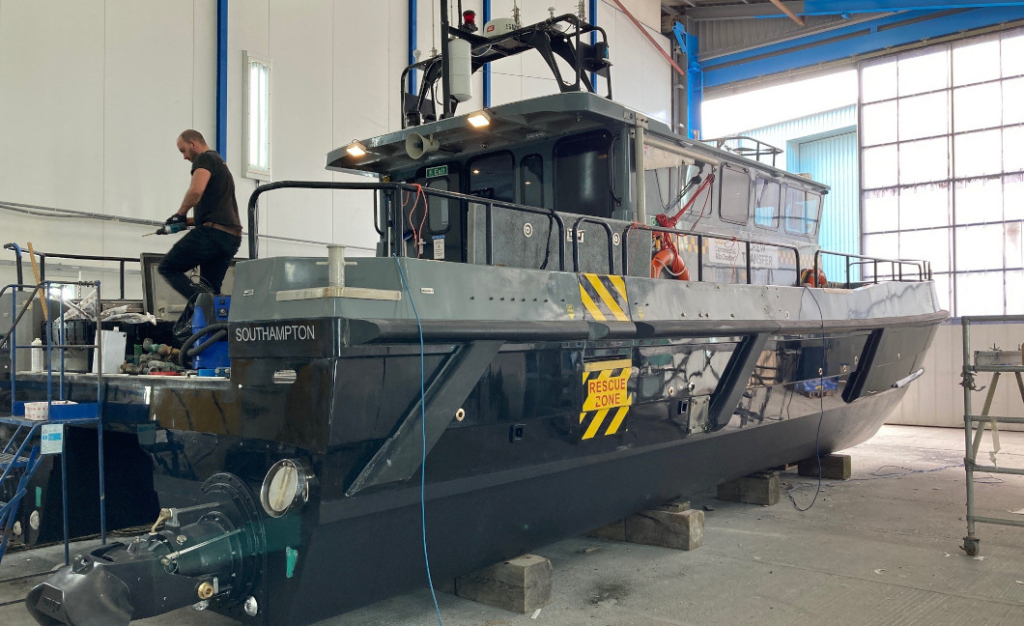
On each model, the jet drives are connected to the engine via the gearbox through an intermediate or ‘universal joint’ shaft. This shaft rotates with the engine power output giving the jet drive the force to draw in water from under the vessel. A grill or screen is fitted flush with the hull to prevent debris being sucked into the jet drive.
 To provide steering and reverse controls, this does differ between manufacturers. On Sentinel for instance, a hydraulic pump on each jet is run from a ‘power take-off’ from the engine. This gives power to hydraulic cylinders that move the nozzle left or right, and the bucket up or down. On MJP and Hamilton Jet units, the hydraulic pumps for these mechanisms are driven by a belt taken off the intermediate shaft itself. This reduces the number of hydraulic hoses and PTOs required and is suitable for the smaller, lower capacity jets.
The advantages of waterjets are, reduced draft, greater manoeuvrability, no risk of entanglement and the ability to reduce thrust rapidly, also known as a ‘crash stop’ without causing damage to gearboxes and shafts. Waterjets have many uses and applications in the marine industry from shallow draft crew transfers to surveying, pilot boat operations and surface supply diving.