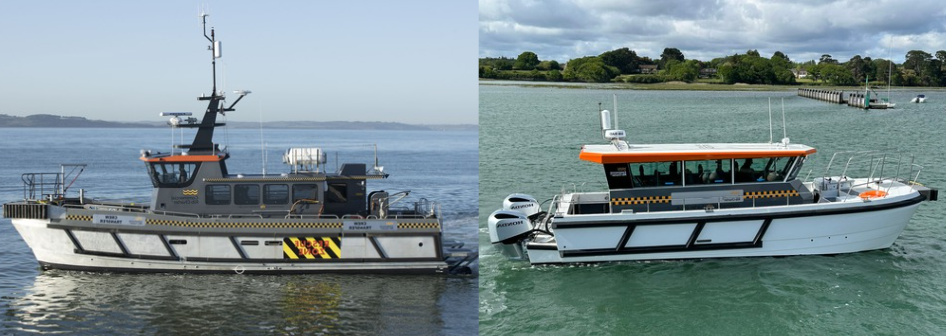


Here at CRC we’ve been lucky enough to have been involved in several new build projects, including CRC Galaxy, CRC Voyager, CRC Vanguard and of course our amphibious crew transfer vessel, CRC Walrus. These projects take a huge amount of focus and resources throughout and involve many people and suppliers.
Sometimes we build vessels purely on speculation but with a good idea of what our clients are demanding, but in other cases we build to a very narrow customer requirement. In the case of CRC Walrus, we worked closely with RWE from the very start and drew up a detailed ‘Scope of Work’ which outlined precisely what the vessel needed to be capable of and what equipment it had to be fitted with.
Next, we approached and commissioned naval architects Chartwell Marine to discuss and create the drawings, following the Scope of Work as closely as possible. This is the point where the hull, wheelhouse and deck layout is refined and all machinery and electronic specifications are decided (among many others). The architects will run sophisticated ‘computational fluid dynamic’ tests and create physical models of the hull to check the vessel’s capability in various weather conditions and sea states.
Once the design is finalised, we will now be approaching the builder’s yard (such as Diverse Marine) to book a build slot and to discuss a timeframe for construction. A contract will be written up and regular payment instalments will be agreed throughout the build to cover the cost of materials and labour.
During the build there will often be daily communication between the yard, designers and us as the client to discuss any snagging issues or complications such as how machinery and systems are fitted or issues with parts availability and supply chains. These will often coincide with visits in person from us to discuss any potential issues well ahead of time, such as deck or wheelhouse modifications. Authorised surveyors will be making regular inspections of the build process to ensure the hull is built to certain structural standards.


As the hull and deck nears completion, focus turns to ‘fitting out’ which includes adding the interior, seating, doors/windows and navigation equipment. This is the point where we will now be ordering up all the coding equipment ready for adding on board, including life jackets, life rafts, EPIRB, mooring lines, life buoys, cleaning equipment and spare machinery parts.
Once the vessel hits the water for the first time, further surveys from the MCA will be carried out including its commercial coding certificate, stability checks, radio communication surveys and IMCA audits. The builder’s yard and ourselves will now be conducting thorough sea trials and commissioning, ensuring all machinery and equipment is working as intended. All engines, generators and jet units will undergo very strict running in protocols, often with the manufacturer present. In most cases, engines can only be run to a specific RPM during the first few hours and must have oils and fluids changed straight away to conform to manufacturer warranties. In the case of Walrus we also had to carry out thorough ‘land’ trials as well as at sea, in order to test the amphibious capabilities on a range of seabed types.
Once all parties are satisfied and the vessel is performing well we will officially ‘take delivery’ and our in-house workshop team will make any last minute touch-ups. Back in the office our commercial team will be hard at work marketing the vessel online and in sales calls, finding the perfect first project for the vessel. Within a few days of delivery we could easily be booking a road transporter to take our new build to its first customer!
Check out our blog library to read our build updates as Walrus went through construction last year. You can see our whole fleet of crew transfer vessels, safety boats, RIBs and dive support platforms here.