

Over the last few years we have been asked more and more from clients what the ‘bollard pull’ of our vessels are.
Bollard pull is a measurement of pulling or towing power of a vessel, defined in tonnes. This term is typically used to describe how much force a tugboat can apply to a ship. The largest tugs in our local port of Southampton have a certified bollard pull of over 60T. For our purposes, knowing the force we can apply to a floating cable during a nearshore cable landing is useful to understand which vessels we should use and how many to supply.
Earlier this year we took advice from our naval architect and carried out tests on our fleet using a 5T load cell hired from Force Logic. A bridle was fixed to each vessel and the load cell was positioned in the middle of a tow line leading to a bollard on the quay. With a wireless receiver providing us with live reading, our skipper slowly increased the RPM to various stages, giving us a reading at different thrust levels.


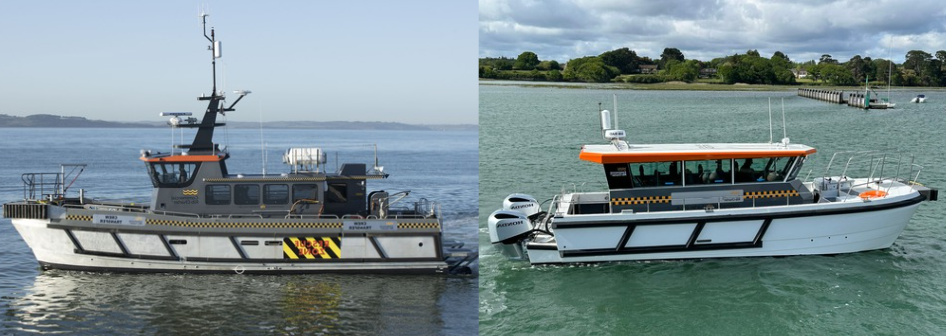
The results, as expected, varied considerably between vessel size, engine horsepower and propulsion type, ranging from 1T on our small 9.5m Cabin Ribs up to 5T on our new 20m catamaran, CRC Sentinel.
There are some caveats however as lots of factors can affect the results including the depth of water you test in, how much rudder angle you are using and how much current or tide is flowing around the vessel. We discovered though that the bollard pull increased considerably when you hit 80-90% of the vessel’s RPM limit, and the jet boats particularly had good pulling power over the bow when pulling astern. Here are some results:
|
Engine Type |
Propulsion |
Bollard Pull |
|
|
CRC Sentinel |
2x MAN V12 |
Jets |
5T |
|
CRC Gladiator |
2x Iveco Cursor 9 |
Jets |
3T |
|
CRC Voyager |
2x Volvo D6 |
Jets |
3T |
|
CRC Vanguard |
2x Suzuki 325hp |
Duoprop Outboards |
2T |
|
CRC Hercules |
2x Suzuki 250hp |
Outboards |
1T |
|
8.8m Open Rib |
1x Suzuki 250hp |
Outboards |
800kg |